
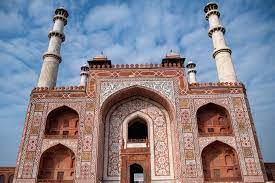
The tomb of Akbar the Great, also known as Akbar’s Mausoleum, is located in Sikandra, a suburb of Agra, India. Akbar was the third ruler of the Mughal Empire, and his tomb is a magnificent example of Mughal architecture. Here are some details about Akbar’s tomb:
Location: The tomb is situated in Sikandra, about 8 kilometers north of the Taj Mahal in Agra, Uttar Pradesh, India.
Construction Period: The construction of the tomb began during Akbar’s reign and was completed by his son, Jahangir, in 1613. The tomb represents a synthesis of various architectural styles.
Architectural Style: The architecture of Akbar’s tomb reflects a combination of Hindu, Christian, Islamic, Buddhist, and Jain motifs, showcasing Akbar’s eclectic taste and religious tolerance.
Layout and Design:
The tomb is built in red sandstone, with some portions adorned with white marble.
The main tomb is situated in the center of a vast garden, which is divided into four equal parts by waterways.
The main entrance is through the southern side, and there are four red sandstone gates on each side, representing the cardinal directions.
The tomb is on a raised platform, and it has a pyramidal structure with three terraces.
The main tomb chamber houses the cenotaph of Akbar. The actual tomb is in the basement.
Decoration:
The tomb is adorned with intricate carvings, inlay work, and geometric patterns.
There are verses from the Quran and other inscriptions on the tomb, showcasing a blend of Persian and Indian calligraphy.
Inscriptions: The tomb contains inscriptions from Akbar’s time, including some of his sayings.
Fatehpur Sikri Influence: The architectural elements of Fatehpur Sikri, the short-lived capital built by Akbar, are also visible in the design of the tomb.
Garden Layout: The Charbagh-style garden around the tomb is a reflection of the Persian influence on Mughal gardens. It is divided into four quadrants by water channels and walkways, symbolizing the four rivers of Paradise in Islamic tradition.
Panch Mahal: Adjacent to the tomb is the Panch Mahal, a five-story structure that served as a pleasure pavilion.
Open for Public: The tomb is open to the public, allowing visitors to explore the beautiful architecture and gardens.